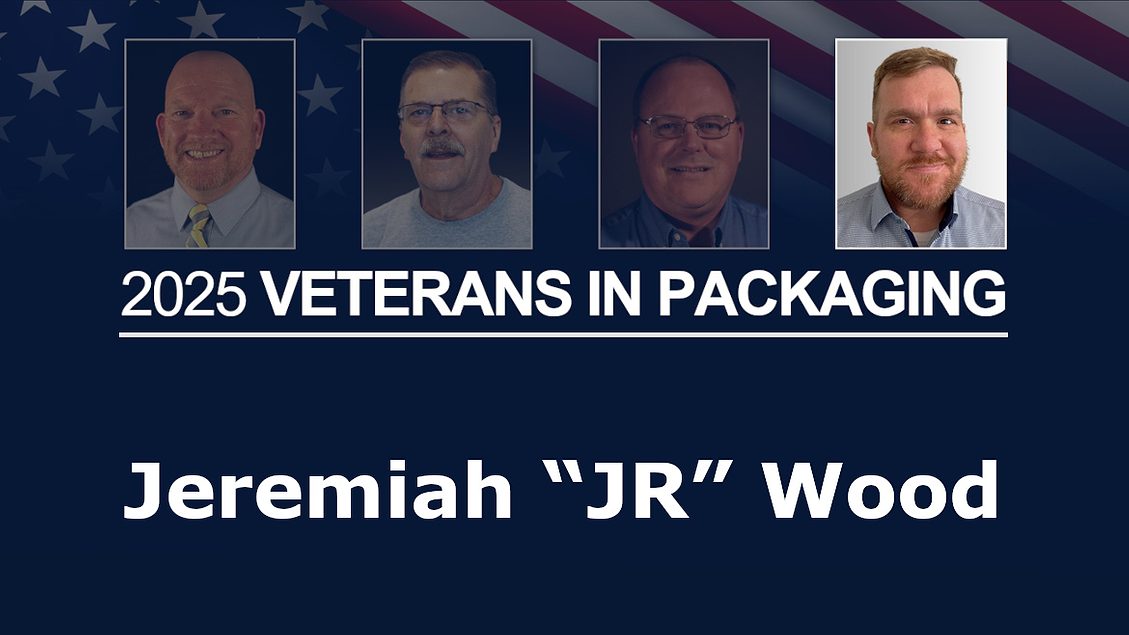
Image courtesy of Jeremiah Wood
PS: Could you tell us a little bit about your military background and what inspired you to serve our country in that capacity?
JW: I served in the United States Air Force for six years as an Electrical and Environmental Technician on F-16 fighter jets with the 148th Fighter Wing out of Duluth, Minnesota. I was inspired by my grandfather’s service in the Army and my own desire to serve our country.
Just two weeks after I completed basic training, the events of September 11, 2001, took place. I was soon deployed in support of Operation Enduring Freedom. Serving during that time was a defining experience that taught me the importance of precision, accountability, and teamwork — qualities that have carried through every chapter of my life since.
PS: What led to your decision to go into packaging and to work at Brenton?
JW: After completing my active duty service, I earned a degree in Electrical Technology from North Dakota State College of Science in 2006. My first job after college was as a service technician for a packaging equipment manufacturer, which gave me hands-on experience with automation systems and complex machinery.
I was drawn to the packaging industry because of its constant innovation and the opportunity to apply the technical skills I developed in the Air Force. Every project presented a new challenge and a chance to learn something different.
I joined Brenton nearly 12 years ago because I wanted to expand my experience in robotics. Brenton’s reputation as a leader in robotic packaging and palletizing made it an easy choice.
PS: What specific training did you receive that ties into your current position at Brenton?
JW: In the Air Force, I was trained to troubleshoot complex electrical and environmental systems, read technical prints, perform stress tests, and make precise repairs on F-16 fighter jets. That technical foundation translated directly into my early years at Brenton as a service technician and later as a robotic controls engineer. The ability to diagnose problems methodically and think under pressure proved invaluable in the fast-paced world of packaging automation.
As my career evolved, I’ve also found that the Air Force’s emphasis on teamwork, integrity, and accountability has carried through to my role today as Regional Sales Manager. Those core values continue to guide how I lead, communicate, and support both our customers and our internal teams.
PS: What are some of the unique skills and perspectives that military veterans can bring to the work environment?
JW: Veterans bring a combination of discipline, reliability, adaptability, and the ability to perform under pressure — qualities that translate seamlessly into any work environment. These traits are often second nature to those who’ve served, and they become especially valuable in industries like packaging, where precision, timing, and teamwork are essential.
In my experience, those same qualities prove invaluable during complex projects at Brenton. Whether it’s coordinating large automation systems or troubleshooting technical challenges, veterans tend to approach every task with focus, accountability, and a commitment to the mission.
PS: What advice would you give to military veterans thinking about entering the packaging industry?
JW: I would tell other veterans to have confidence in their technical skills but also recognize the tremendous value of the soft skills learned through military service. Traits like reliability, integrity, and the ability to perform under pressure are highly valued.
The packaging world is fast-paced, innovative, and team-oriented. It’s an environment where problem-solving happens daily, and where veterans’ adaptability and mission-focused mindset can make a real impact. If you’re looking for a career that combines technology, teamwork, and the satisfaction of helping customers succeed, packaging is a great fit.