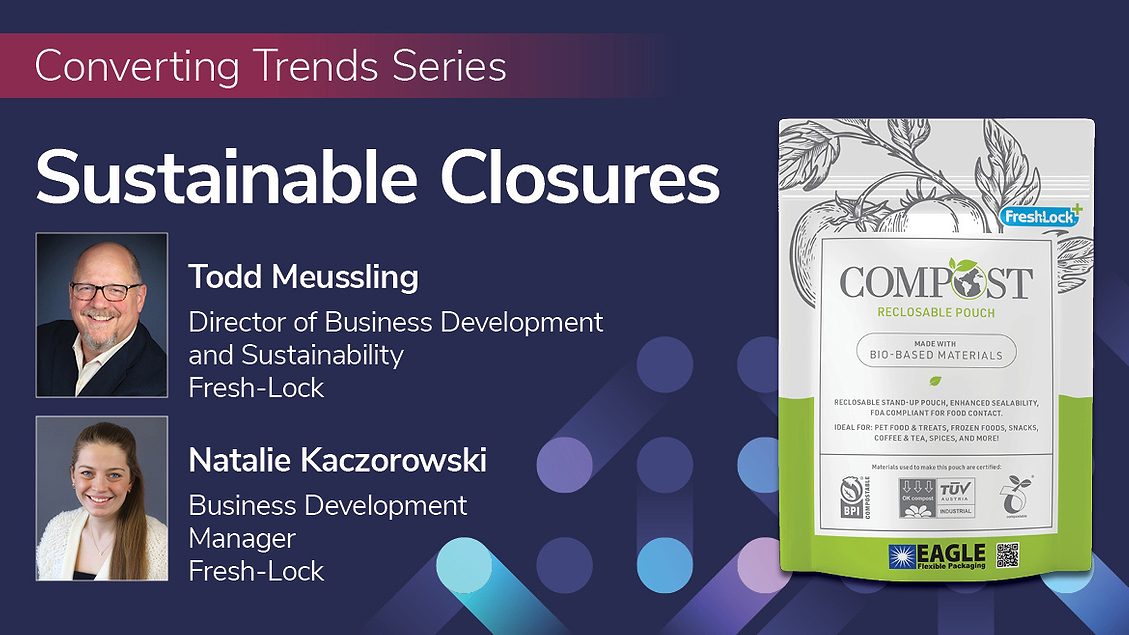
We recently spoke to Todd Meussling, Fresh-Lock Director of Business Development & Sustainability, and Natalie Kaczorowski, Fresh-Lock Business Development Manager, about closure options for converters seeking to improve flexible packaging sustainability.
PS: What factors are most influencing converters’ decisions to adopt sustainable closures today?
TM: Flexible packaging faces many of the same evolving demands experienced across industries in today’s economic landscape. Extended Producer Responsibility (EPR), total package costs, and sustainability are common topics of conversation the Fresh-Lock team has with both brand and converter customers. Factors that influence converters’ closure decisions are predicated on solutions that meet these demands while also providing process efficiency, fit-for-use performance, and consumer satisfaction.
Todd Meussling, Director of Business Development & Sustainability, Fresh-Lock. Image courtesy of Todd Meussling

Natalie Kaczorowski, Business Development Manager, Fresh-Lock Image courtesy of Fresh-Lock
PS: How do converters balance sustainability goals with performance requirements and operational efficiency?
TM: It all comes down to collaboration with their suppliers. Solid collaborations begin with everyone having a clear understanding of the converter’s package objectives. It’s from these objectives that we look to identify trade-offs between sustainability targets and operational efficiency. While most of our customers want to be able to incorporate sustainable solutions, benefits of sustainability might diminish if process waste increases or package performance decreases. From a closure standpoint, it’s our job to offer product options which optimize this balance.
PS: How does Fresh-Lock help support converters that are transitioning to sustainable closure solutions?
TM: Fresh-Lock® closures was an early innovator in closures for flexible pouches, so we understand the critical relationship between materials, equipment, and process. For example, a switch from a multi-material film to a recyclable, mono-material structure can significantly reduce the operating window in pouch conversion. As we’ve continued to innovate and meet the changing demands of the flexible packaging industry, we take pride in the expertise our R&D and Technical teams bring as converters seek to incorporate more sustainable solutions into their packaging portfolios. From material selection to collaborative problem-solving, the Fresh-Lock team works closely with customers to help meet their sustainability goals and close the gap in circulatory without compromising on operational efficiency or pouch functionality.
PS: What are some common concerns/misunderstandings that converters may have when it comes to switching to sustainable closures? How does Fresh-Lock address these concerns?
NK: We continue to be optimistic on sustainability in flexible packaging and see advancements in feedstocks, material design, and equipment improvements designed to run with improved efficiencies. Some converters hope for a “one-size-fits-all solution” to closures. Depending on the applications, this may be possible, but brands have different products for different applications, often with their own sustainability objectives. This requires converters to produce a variety of structures and pouch formats, necessitating more than one type of closure solution.

Image courtesy of Fresh-Lock
Recognizing this need, we developed the Fresh-Lock® 8000 Series, a line of sustainable closures for flexible packaging targeting circularity and waste elimination. The goal is to help provide recyclable packaging to the marketplace with minimum reduction in production efficiencies. At the same time, the wide range of closures available in the portfolio ensures that no matter the application, there is an option that will help provide the ideal consumer experience and support the sustainable practices consumers expect from companies.
PS: Which sustainable closure options are currently most popular among converters who are looking to improve flexible packaging sustainability? Why?
NK: Flexible packaging is trending from complex, multi-material laminations toward mono-material options like polyethylene (PE) structures. As a result, recyclable, mono-material closures continue to gain attention, and are popular as brands and converters prioritize Recycle Ready packaging formats that align with evolving regulations and retailer sustainability goals. As EPR legislation evolves, we expect increased demand for products with post-consumer recycled content (PCR), to grow as well, which will add to circularity objectives.
We also see interest in paper-based and fiber-based flexible packaging. Converters are producing paper-based structures that can deliver low- to medium-barrier performance, enabling brands to transition into fiber formats across applications such as dry foods, snacks, pet food, and home care. This momentum is driving increased demand for fiber-compatible closure solutions, which the Fresh-Lock team can offer.
PS: What advice would you give converters who want to explore sustainable closures but aren’t sure where to begin?
NK: When it comes to the success of sustainable closures, collaboration is key. Most successful packaging projects require input from key stakeholders, including the brand, converter, and the material and equipment suppliers. Team dialogue helps with alignment on project targets, sets clear expectations, and offers a forum for ideation. Our advice: reach out to key suppliers in the early stages to provide support and engage them throughout the project.
By anchoring development around customer goals and building strong technical connections, converters can move faster, innovate more effectively, and bring scalable sustainable solutions to market with confidence.