Compostable materials for flexible packaging have continued to see growth and innovation over the last decade. In the United States alone, community composting programs have grown from covering 2 million households a decade ago to nearly 15 million as of 2023.
Available compostable materials have developed from single-source materials with limited application to multi-layer laminates that emulate the barrier properties and performance of conventional plastic packaging. Packaging converters are positioned between material suppliers and brands, bringing packaging designs to life for a variety of consumer-packaged goods (CPGs).
Because of this role, converters’ offerings are often driven by the needs and preferences of their customers. Recyclable and post-consumer recycled (PCR) materials are well-known, but their end-of-life story is not always as successful as intended. Offering compostable packaging materials alongside recyclable offerings can provide a premium differentiator for converters and improve the lifecycle for flexible packaging.
Where Compostables Fit in the Market
With conventional plastics as the industry benchmark for performance, innovation in the compostable materials space has closed the gap. A common misconception is that compostable materials don’t stand up for high-barrier needs and that complex, multi-ply solutions are not available. In the market today, compostable packaging performs on shelf life with high oxygen and moisture barriers, strong printability and sealability, and superior strength and durability. In fact, some compostable materials excel over conventional plastics in applications such as fresh produce packaging, complex laminate applications, and labels.
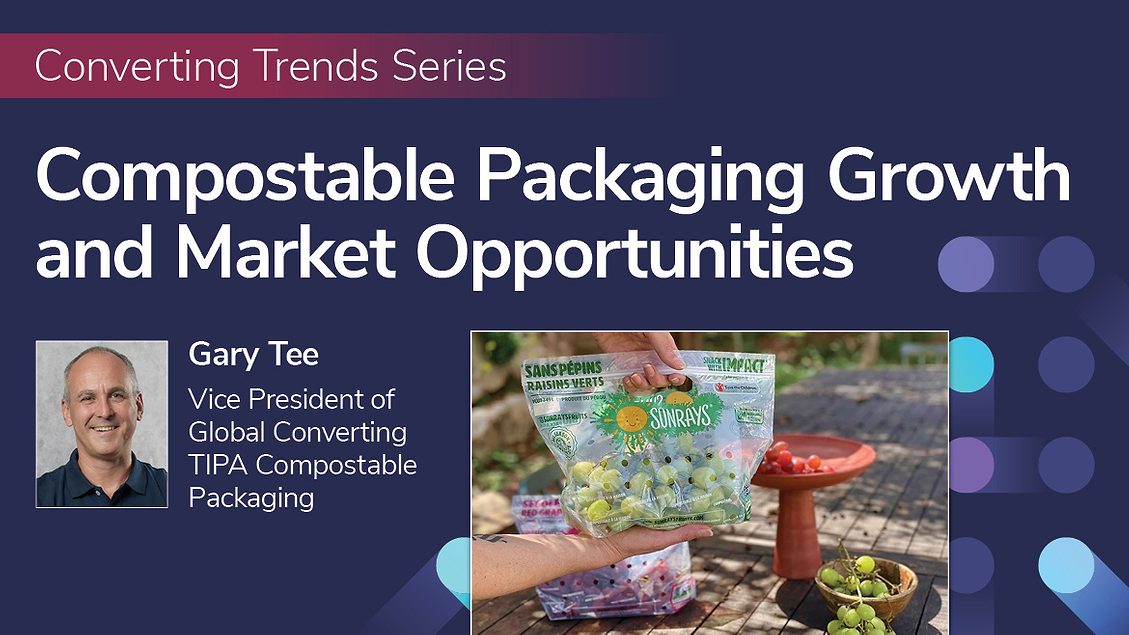
The fresh produce category includes some of the shortest shelf-life products in the food market. Compostable materials have been shown to extend produce shelf-life, resulting in fewer quality losses and less food waste for producers, retailers, and consumers. The inherent properties of the compostable material offer an advantage in fresh produce that cannot be replicated with conventional plastics. Compostable materials also provide a better end-of-life opportunity for disposal alongside the food scraps.
When it comes to high performance with flexible packaging, solutions typically involve complex multi-layer solutions using a combination of films. Compostable films, similar to conventional films, can be layered to create complex laminates that perform in high-barrier applications. These layers all compost under the same conditions, eliminating end-of-life challenges compared to the conventional application. When layers of recyclable conventional films are combined for performance, they must be separated at specialized recycling facilities to actually achieve recycling. Because this is challenging, it becomes unlikely that the product will be recycled.
End-of-Life Challenges and Opportunities
As recyclability has been at the center of the sustainability conversation, many converters understand recyclable packaging material options and can easily guide brands on its performance properties. Converters also likely know that the end-of-life story for recyclables is grim. The Ellen MacArthur Foundation estimates that only about 14% of recyclable plastic is actually collected for recycling. The Film and Flexibles Recycling Coalition further estimates that only 2% of U.S. households can put flexible packaging in their recycling containers, and when they do include them, the recycling stream becomes contaminated due to the lack of processing infrastructure for these particular formats.
The conversation of contamination is complex. While compostable flexible packaging should not be recycled and would contaminate recycling streams, so can recyclable flexible packaging that is not certified curbside recyclable. Conversely, when conventional plastics end up in organic waste streams, that is also problematic. The solution is equally complex. Streamlining waste streams to avoid contamination will require ongoing innovation in plastics identification and infrastructure build-out at recycling centers, and expansion of collection options for both composting and recycling. Consumer education will also continue to be a key piece of ensuring circularity.
However, compostables are already providing key opportunities today where conventional plastics have near insurmountable challenges. Compostable materials are gaining traction as the ideal solution for produce labels. Where conventional plastic labels can easily and inadvertently contaminate organic waste streams when not removed, compostable labels can simply join the food scraps on their compost journey. Additionally, small-format applications like nutraceutical powders, beverage mixes, or condiment sachets are unlikely to be recycled today due to their size and residual contents remaining on the packaging. These factors do not inhibit composting.
The availability of consumer composting programs continues to rise, with more than 4,700 composting facilities throughout the country. Using compostability as part of a brand’s sustainability message while educating consumers on packaging will continue to drive adoption, and converters play a key part of this conversation.
Incorporating Compostable Offerings
As packaging consultants, converters have a key opportunity to bring compostable solutions to brands and use it to elevate their own positioning. Compostables are a premium offering that brands can use to elevate their market position by both speaking to sustainability and being able to deliver on those eco-friendly claims. Making compostables a part of the conversations in turn gives converters a high-value offering and further differentiates them in the marketplace.
Compostable materials today are also designed to be run on conventional equipment. Partnering with a compostable supplier that prioritizes operational, logistical, and technical support will make your journey into offering compostables seamless. With expertise across recyclable, PCR, and compostable options, converters can find solutions that meet the needs of brands and help address end-of-life challenges for flexible packaging.