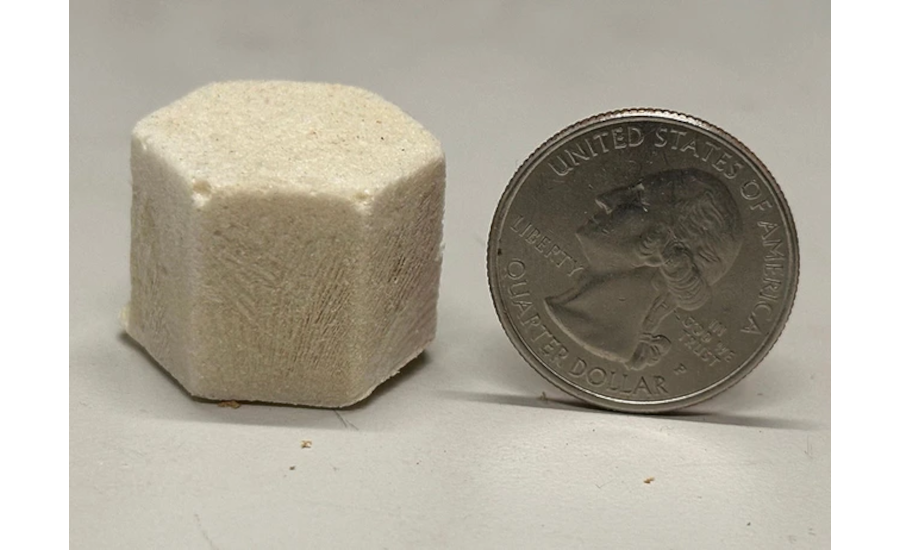
The International Molder Fiber Association (IMFA) recently shared the findings that sawdust-based foam may offer a sustainable alternative to polystyrene. Researchers reporting in American Chemical Society (ACS) Applied Polymer Materials worked to develop a sustainable alternative. The researchers tested an unconventional starting material: sawdust.
Prototype foams incorporated cellulose binders combined with other additives to form rigid or flexible materials. Some prototypes matched polystyrene’s strength and impact resistance, researchers noted. With a simple beeswax coating, the prototypes were made to be water-resistant and produce biobased foams with potential for packaging and building materials. Traditionally, polystyrene is manufactured from fossil fuels.
“It can be exciting to use waste products as a starting point for materials fabrication, rather than a chemical catalog,” said Todd Emrick, the corresponding author of the study, in a statement.
Emrick noted that the first author of the paper, Isha Farook, traveled to nearby farms and sawmills to ask if the research team could have their sawdust waste. Once it was dried, both researchers found that the waste sawdust created well-performing foams.
Emrick, Farook and colleagues blended sawdust in the lab, using different combinations of cellulose binders and cross-linked ingredients. Researchers then poured the mixtures into molds, froze them and freeze-dried the foams to remove all the moisture. Finally, heat-drying activated the cross-linked networks.
The properties of the foam prototypes varied depending on the cellulose binders: carbomethyl cellulose versions were stiffer than polystyrene, while hydroxypropyl cellulose produced a softer material. The researchers observed minimal difference between the foams made with processed versus unprocessed sawdust.
Stability tests showed that, unlike polystyrene, the biobased foams containing cross-linking ingredients absorbed and released water while resisting dissolution in acetone. Certain foam samples were coated in beeswax, which improved the water resistance when exposed to high humidity. The coating did not influence the material’s mechanical properties.
“We haven’t done a long-term stability study yet,” Emrick said. “But in the weeks-to-months’ time frame, the liquid stability appears to be excellent, which is a useful feature during shipping in case of leakage or spills, or simply for production and storage under different environmental conditions.”
The researchers also conducted impact tests with a 10-pound weight. They observed that the biopolymer foams dispersed energy better and bounced the weight 21% less distance than polystyrene of similar thickness. Such results suggest that the sawdust-based foams are robust enough for packaging applications where polystyrene is currently being used.
“The initial driver for this work was in packaging foams, which are used in abundance to protect materials in transit,” Emrick said. “Because our initial assessment of mechanical properties appears promising, such sawdust-based foams may be examined further in all sorts of applications — including construction materials and high-end packaging for consumer electronics, where lightweight and protective packaging is essential.”
The authors of the work thanked Hadley Millworks for providing waste sawdust and acknowledged funding from the U.S. Department of Energy.