As part of Nestlé’s continuous efforts towards more sustainable packaging solutions, the company is launching paper-based innovations across major brands.
Recently, Nestlé introduced paperboard canisters for its Vital Proteins brand in the United States. This packaging material and design change results in a 90% plastic reduction from previous packaging. Developed by experts at the R&D center for Nestlé Health Science in Bridgewater, New Jersey, in collaboration with external partners, the new canister has a proprietary coverlid that is rigid and tight. It allows for easy opening and closing of the canisters, while being leak and spill-proof, as well as durable for everyday usage.
Additionally, Nestlé’s global R&D network is working alongside external partners and suppliers to develop the next generation of high barrier paper packaging solutions across product categories.
Gerhard Niederreiter, Head of Nestlé’s Institute of Packaging Sciences, explains: “When developing paper packaging, we consider each product’s sensitivity to external elements such as oxygen, temperature and moisture. Starting with less sensitive products, Nestlé’s paper packaging journey started in confectionery including Smarties and KitKat and is now advancing to product categories such as coffee which require higher barrier protection.”
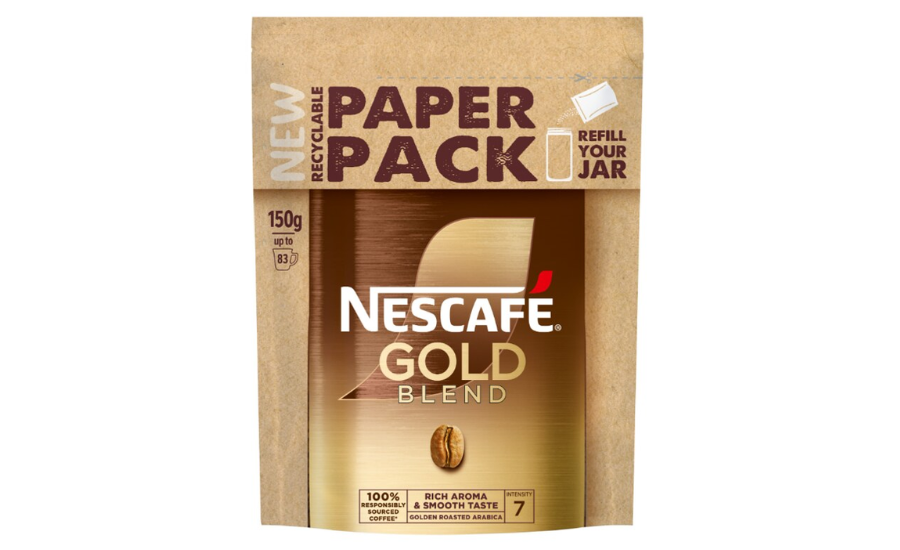
In the United Kingdom, Nestlé recently introduced a high-barrier paper refill pack for Nescafé. This refill paper packaging solution allows consumers to replenish their glass Nescafé jars at home without having to compromise on product freshness or quality. This reduces packaging weight by 97 percent and the paper packaging can be recycled in the local paper waste stream.
In addition, the Nescafé Cappuccino range in Europe now has new packaging featuring a paper-body instead of the previous plastic can. It is fully recyclable in the paper waste stream across Europe, where this packaging format is available in different product varieties.
Axel Touzet, Head of the Coffee Business Unit for Nestlé, says: “Coffee is particularly sensitive to oxygen and humidity. This is why redesigning packaging for this product category requires additional efforts to ensure we can safeguard product freshness and quality with science-based and sustainable solutions.”
These cross-category packaging innovations build on Nestlé’s unique expertise and company-wide efforts to reach its 2025 packaging sustainability aim of designing 95% of its plastic packaging for recycling and reducing the use of virgin plastic by one third.