The global coding and marking equipment market is on a clear growth path. As portrayed by a recent Grand View Research report, the coding and marking equipment market was worth $17,528 million worldwide by the end of 2024. Furthermore, GVR’s projections estimate its value will reach $24,927 million by 2030, with a significant 6.1% CAGR. As the research’s findings suggest, this expansion is primarily driven by the industrial sectors where identification and traceability are becoming more and more critical – namely pharmaceutical, food & beverage, cosmetics, and electronics.
Specifically, F&B stands out at the very top, accounting for more than one third of total market demand by the end of 2024. It’s easy to assume that one reason is that the food & beverage segment is noticeably one of the most regulated across countries all over the world. In the United States, for example, the regulatory backdrop is defined by the Food Safety Modernization Act (FSMA), requiring robust recordkeeping that facilitates rapid trace back and trace forward of foods.
Moving forward to a technological point of view, the aforementioned report highlights that inkjet systems stand out as the more widely employed by businesses all over the world: continuous inkjet alone accounts for over 30% of global market share, while thermal inkjet is expected to be the fastest-growing segment over the 2025–2030 horizon.
That said, inkjet is not always the optimal choice in every food & beverage scenario. Specifically for beverages packaged in aluminum cans, application environments often combine very high line speeds with wet or condensing surfaces. Under those conditions, alternative technologies may deliver more consistent results and lower operational risk than inkjet alone.
From inkjet to fiber laser marking: Pepsi Bottling Ventures’ case study
At this point, it should be pointed out that high-capacity beverage lines represent a real challenge for most marking and coding systems. In detail, when high speed operations and strict precision requirements combine with wet environments – and condensation forms on aluminum cans’ surface – inkjet solutions don’t always represent the most reliable option. Under these conditions, the interaction between ink and condensate-coated metal can cause visible variability and undermine first-pass readability. Furthermore, it should be noted that attempts to cope with similar situations tend to add complexities such as more intense energy utilization, as well as downtime occurrences. In fact – in their effort to render aluminum cans suitable for inkjet coding – facilities tend to employ pressurized air blowers, which translates into more energy-intensive and time-consuming processes.
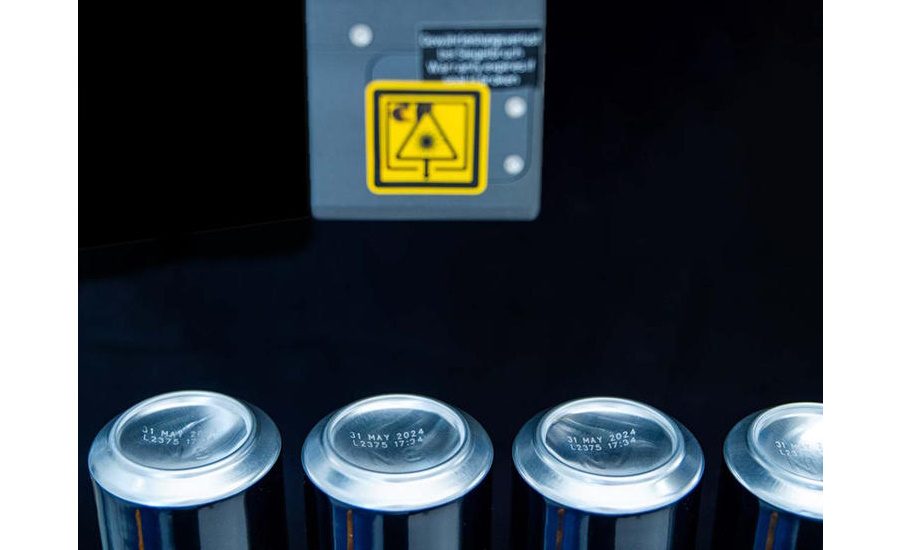
Aiming to address those operational challenges, Pepsi Bottling Ventures opted to switch from inkjet to Domino’s fiber laser coding technology, installing F720i systems for direct application on aluminum cans. In detail, F720i fiber laser printers use optical fiber cables doped with special atoms to generate and guide light. Moving through the doped fiber, the light is amplified, producing highly focused laser beams that can engrave metallic surfaces, such as aluminum.
Pepsi Bottling Ventures’ primary goal behind the adoption of fiber laser as a substitute to inkjet was the stabilization of the print quality at line speed, reducing sensitivity to condensation at the same time. In fact, “with ink jet coding, the ink doesn’t always land where you want it,” notes Mike Collins, General Manager at PBV. Following the switch, the reported outcome was high-resolution, permanently readable codes applied to more than 100,000 cans per hour.
As previously mentioned, another practical reason for the transition was, in fact, the humid atmosphere itself. “With ink jet coding you really have to put in a lot of hot air to get it to where [the can is] dry,” says Collins. By doing away with drying requirements, line engineering is simpler and less energy intensive.
In short, as Pepsi’s engineering unit vice president Sabri Kundakcioglu highlights: “Quality, productivity, and sustainability … these are the three reasons that we converted our can coding to a fiber laser … Line efficiency is improved, cost of production has been reduced, and customer complaints about poor printing quality have been reduced.”
From a total-cost-of-ownership perspective, in fact, moving from inkjet to fiber laser eliminates inks and solvents, along with their storage, handling, and disposal. It also reduces the need for hot-air drying or dedicated climate control, translating into lower energy consumption.
In high-speed, wet environments, these practical differences go a long way in explaining how a laser-based approach to coding can be more reliable and entail lower operational risk than inkjet.
Conclusion
In conclusion, choosing the right coding and marking technology requires careful evaluation based on a wide array of variables. Navigating technical and practical complexities associated with specific industrial segments — and their related necessities — is where experience really pays off. That’s why working with reliable and competent partners is crucial.
With a long track record in industrial marking and labelling – as well as strategic partnerships with top brands all over the world such as Domino, whose laser and inkjet solutions Nimax delivers and supports in Italy, Denmark, Uganda, Tanzania and Kenya – Nimax S.P.A. combines hands-on consulting with cutting-edge solutions designed for seamless integration, ultimately helping businesses to focus on what really matters and getting the most out of it.