✕
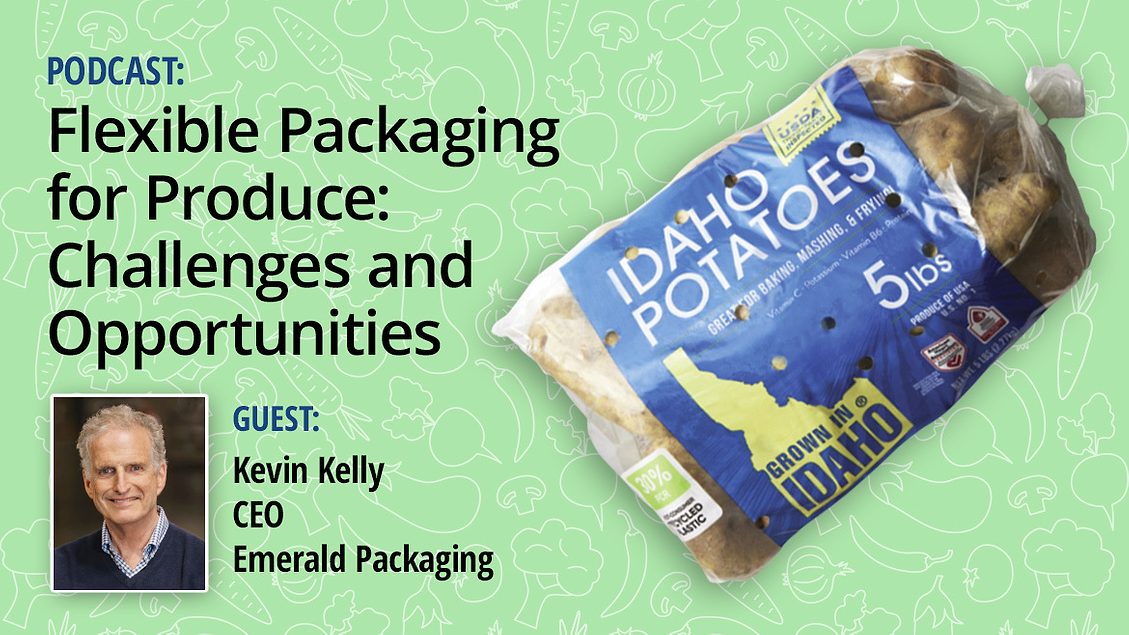
Emerald Packaging recently made the news by partnering with Idaho Package, Wada Farms and Walmart to introduce the first 30% food contact Post-Consumer Recycled (PCR) bag for the potato category. Kevin Kelly, CEO of Emerald Packaging, joined us to discuss this success story and the challenges of getting brands and retailers to adopt sustainable flexible packaging.
“We were able to formulate a plastic containing 30% PCR that didn’t break when 10 pounds of potatoes fell five to 10 feet into it during the potato packing process. Wada Farms adopted it, and Walmart signed off on it,” Kelly explains.
Kelly says it’s not the lack of technology that prevents sustainable packaging from entering the market. Many times, it’s the unwillingness of brands and retailers to accept the extra cost.
“We can put 20-30% PCR into any bag for about a 3-8% price increase, and you would be surprised at the number of produce companies that just say, ‘No. We can’t afford it. We can’t pass it through.’ I think that has been the biggest stumbling block,” Kelly said.
Emerald Packaging is the first packaging converter to participate in the US Flexible Film Initiative (USFFI), a non-profit membership organization helping to advance scalable solutions to recycle flexible plastic packaging.
Packaging Strategies recently reported on the Sustainable Produce Packaging Alignment releasing its “Roadmap to Sustainable Produce Packaging,” an endeavor spearheaded by Western Growers and the Canadian Produce Marketing Association (CPMA).
Kelly was involved with developing the roadmap and boils down the coalition’s argument for not eliminating produce packaging to “form versus function.”
“Produce packagers have the honor of providing packaging to keep a living product alive,” Kelly says. “It’s the extension of shelf life that allows the product to get to Ottawa fresh and on the shelves and into someone’s refrigerator and survive for 21 to 30 days.”