✕
It’s no secret that coatings are a critical component when it comes to enhancing the durability, aesthetics, and functionality of a wide array of packaging materials across industries such as food and beverage, pharmaceuticals, and consumer goods. However, with the rising demand for sustainable packaging on the part of both regulators and consumers, it’s important that coatings don’t stand in the way of compostability or recyclability.
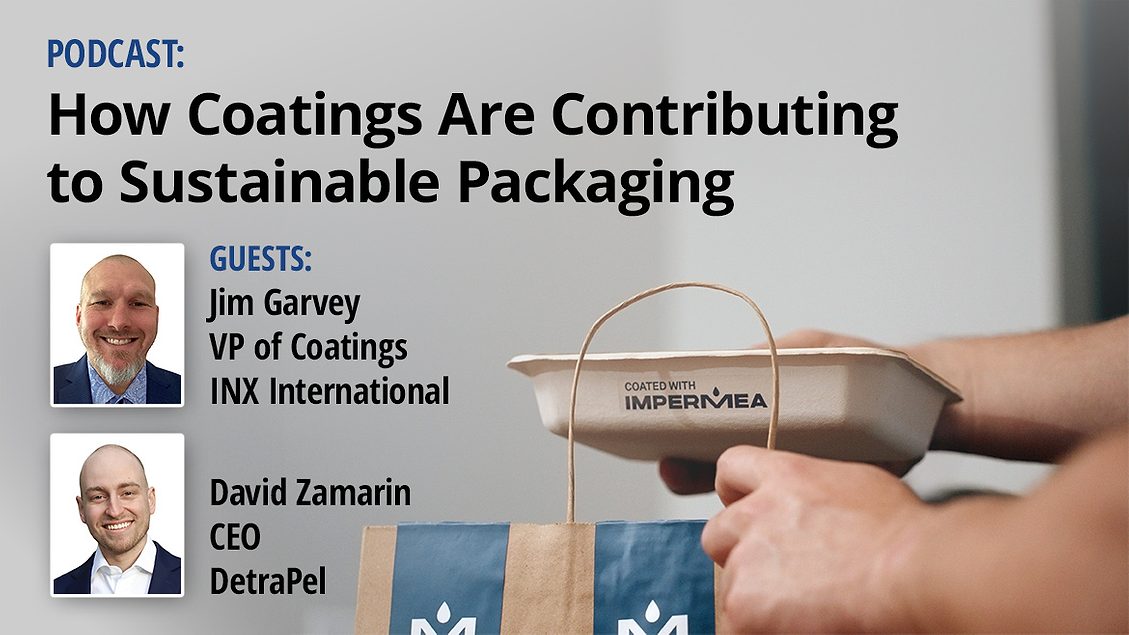
To discuss how the latest coating technologies improve packaging functionality while also speaking to sustainability, we recently spoke to Jim Garvey, Vice President of Coatings at INX International, and David Zamarin, CEO of DetraPel.
Note: In 2023, INX International completed an investment in DetraPel, which is the parent company of Impermea Materials.
Garvey and Zamarin note that material reduction is one of the key advantages of the latest generation of barrier coatings. The latest technology allows brands and converters to choose mono-material coating options that eliminate the need for, say, polyethylene (plastic) or fluorinated additives (PFAS).
Garvey added that one of the most exciting developments as far as Impermea’s product offerings are coatings that are heat-sealable.
“Historically, in order to get a very good grease barrier or water barrier or air barrier, it was not something heat-sealable. Some of these coatings now not only perform extremely well at keeping out or keeping in what they’re intended to do, but they’re able to be heat-sealed, which then eliminates different adhesives and glues,” Garvey said.
While these advances contribute to coatings qualifying as either recyclable or compostable — which is important — Zamarin touched on some of the other ways that the latest technologies help reduce the environmental impact of coatings.
“Because these are going to be lighter-weight materials, the paperboard will be lighter weight. It has lower cure settings, so you also then require less energy to cure the coating,” Zamarin said. “It just depends on which way the customer is looking at it, but we kind of take this holistic approach and realize that it’s a lot more than just recyclability or compostability.”