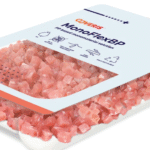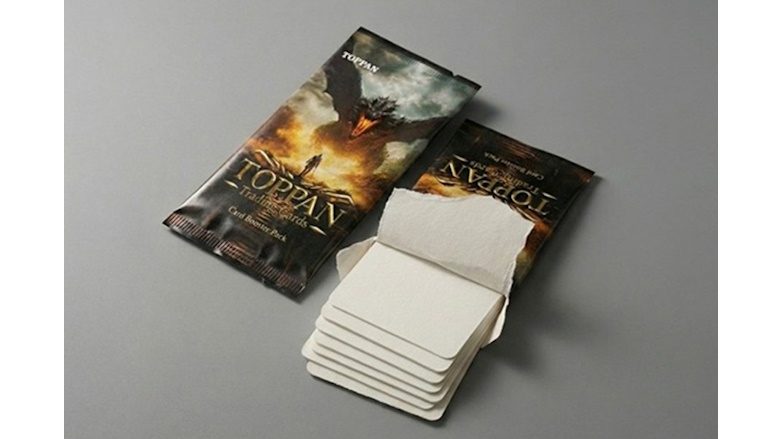
TOPPAN Inc. has developed Japan’s first1 light-shielding, paper-based pillow packaging for trading cards. Samples of the new packaging will be made available to trading card manufacturers globally from June.
The proprietary material composition eliminates plastic completely from the packaging and replaces it with paper.
“An issue with paper-based packaging has been that contents can be seen through the paper,” the company notes. “TOPPAN’s new packaging resolves this with outstanding light-shielding of 98% or more, deterring so-called pack searching, where consumers attempt to identify rare cards before opening, while maintaining design quality with a metallic sheen. TOPPAN has also achieved a high-quality finish by developing dedicated equipment that minimizes the occurrence of wrinkles during the pouch-making process.”
TOPPAN plans to begin mass production in Autumn 2026.
Background
The Japanese trading card market has expanded rapidly in recent years, with the market size in fiscal 20242 surpassing 300 billion yen, roughly three times that of fiscal 2019. As collaborations with various industries—including apparel brands and restaurant chains—continue to increase, trading cards are becoming firmly established as a culture that transcends generations across the world.
Meanwhile, rising environmental consciousness is driving stricter regulations on packaging materials, particularly in Europe. This has prompted urgent calls to reduce greenhouse gas emissions and accelerated the shift away from plastic. Consequently, trading card manufacturers operating globally are increasingly required to adopt eco-friendly packaging designs.
However, adopting paper materials for trading card packaging presents significant challenges. It requires superior light-shielding performance to reliably protect the contents and prevent “pack searching” before opening. Furthermore, specialized forming technology to minimize wrinkling and a robust production system to consistently ensure high quality are also essential factors.
Leveraging its extensive expertise in paper-based packaging development and production, TOPPAN has selected the ideal material and developed dedicated pouch-making equipment. Through these efforts, TOPPAN has successfully overcome the inherent transparency of paper, minimized wrinkling, and established a stable supply system for high-quality, paper-based pillow packaging.
Features of TOPPAN’s New Packaging
Achieving zero plastic usage
Conventional plastic packaging typically combines plastic materials for structural strength and adhesive sealant layers. In contrast, TOPPAN’s new packaging achieves zero plastic usage through a proprietary composition consisting solely of a paper base and a heat-seal coating layer.
Furthermore, since the paper content exceeds 51% by weight, the packaging qualifies for the “Paper Mark” (recycling symbol for paper) in Japan. This allows companies to visually communicate their commitment to resource circulation and sustainability to consumers.
Preventing “pack searching” with superior light-shielding and a metallic finish
By applying aluminum vapor deposition to the paper material, TOPPAN has achieved a high light-shielding rate of 98% or more. This effectively eliminates the inherent transparency of paper, preventing “pack searching” by ensuring the contents remain invisible until the package is opened.
Additionally, the structure allows for direct printing onto the aluminum vapor deposition layer. This enables a premium metallic finish and ensures vivid colors and design fidelity comparable to those of conventional plastic packaging.
High-quality finish with minimal wrinkling
TOPPAN has developed dedicated pouch-making machinery by optimizing feed rollers and developing specialized jigs for the folding unit. This machinery minimizes wrinkling in paper-based pillow packaging while achieving high-speed folding. By deploying this equipment, TOPPAN has overcome the traditional challenge of wrinkling in paper-based materials and established a stable supply system for high-quality packaging. Mass production on a dedicated line is scheduled to commence in Autumn 2026.
Future Activities
TOPPAN plans to establish a supply system capable of producing 30 million packs per year by the start of mass production in Autumn 2026. Through the provision of this product, TOPPAN is committed to supporting trading card manufacturers and related companies—both in Japan and overseas—in their efforts toward environmental sustainability and global expansion.