Packaging is no longer merely a functional necessity; it has become a critical component of modern business strategy. As consumers, regulators and investors increasingly prioritize sustainability, the way packaging is designed and disposed of must change. According to McKinsey research, roughly 80 percent of packaging materials globally are thrown away after just one use. While cardboard is a recycling staple, the “multi-material obstacle” in ecommerce—defined as the use of plastic tape, foam inserts and bubble wrap inside a box—presents a significant technical bottleneck for a truly circular future.
The Problem with Linear, Mixed Packaging
Most packaging today follows a linear pathway: produce, use, discard. According to the Environmental Protection Agency (EPA), packaging accounts for nearly 30 percent of all municipal solid waste. For industries like technology, automotive and consumer goods, this waste represents lost value.
The primary barrier to circularity in fulfillment is material incompatibility. Most recycling facilities rely on automated sorters that struggle with mixed materials. When plastic films or foam are bonded to cardboard, they often contaminate the recycling stream, which produces a lower-quality recyclate or diverts the whole unit to a landfill.
This linear approach is also costly. Traditional void-fill packing is a labor-intensive, five-step process that requires operators to manage multiple SKUs and secondary machines for paper wadding or plastic inflation. This adds weight to shipments, increases storage requirements, and generates unnecessary material costs.
A Technical Shift: Integrated Mono-Materials
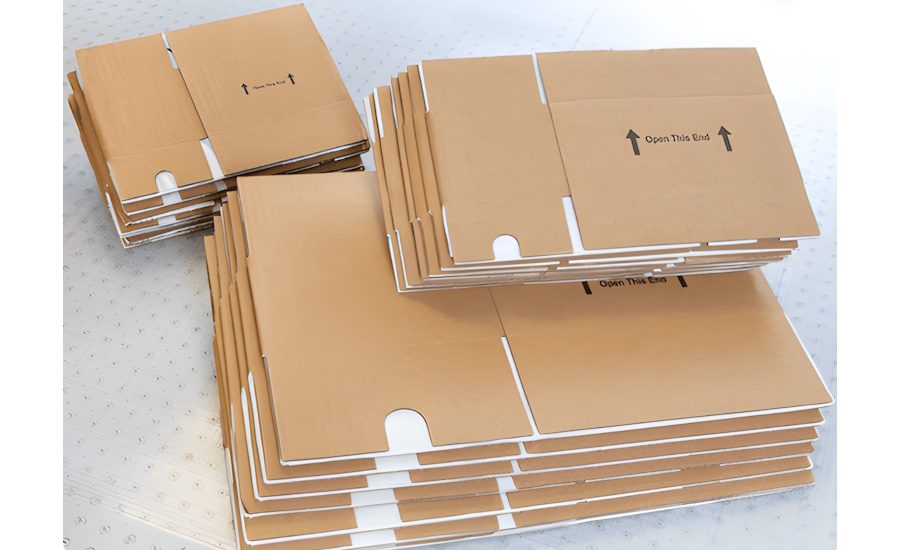
Designed to be durable and recoverable, circular packaging flips the traditional model by keeping materials in circulation. To solve the multi-material trap, engineers are now developing customized, integrated retention systems that build protection directly into the carton structure. By using an all-paper retention system, the industry can eliminate the need for plastic or loose-fill materials.
This approach relies on a specific technical mechanism, or a built-in, cohesive kraft liner. The liner is chemically engineered to adhere only to itself, not the shipped product. Once a product—like personal care items or industrial components—is placed inside, the liner is crimped around it to create a secure, custom “nest” that secures the item into place for shipping. Because the system is 100% fiber-based, the end-user can place the entire unit into a standard curbside recycling bin without “stripping” the box of tape or foam. This ensures a cleaner, high-value recycling stream.
The Advantage of Mono-Materials
Moving to an integrated mono-material design fundamentally alters the economics of the fulfillment center and provides clear advantages. By eliminating the manual handling of secondary void-fill, companies can increase throughput velocity, making the packing process 40% to 50% faster than conventional methods. Additionally, high-volume shippers can realize total packaging cost savings between 15% and 30% through reduced material SKU complexity and lower dimensional weight.
Looking Ahead
The “multi-material obstacle” is a design challenge that the packaging industry is finally equipped to solve with circular packaging, and that shift is achievable with thoughtful design and supply chain planning. For many organizations, like retail, the transition to integrated, mono-material solutions is proof that circularity and fulfillment speed are not mutually exclusive. By engineering waste out of the carton at the design stage, businesses will not only reduce environmental impact but will also position themselves ahead in a marketplace increasingly defined by sustainability.
We stand at a crossroads: Companies that cling to single-use, disposable models risk falling behind, while those that embrace circular strategies will be better positioned for the challenges of tomorrow. Ultimately, circular packaging isn’t just good for the planet; it’s good for every business’s bottom line.