Efforts to increase sustainability in dairy packaging have often centered primarily on materials: what the carton is made of, where the board comes from, and whether the cap is recyclable. While Life Cycle Assessments (LCA) have shown that carton packaging carries a significantly lower carbon footprint than many alternatives,1 material choices alone don’t determine a sustainable outcome. Even when a product is packed in a mainly renewable carton, losses on the filling line at every changeover turn it into a waste issue that needs addressing. True sustainability must follow the product through the entire lifecycle, from start to finish.
This is why improving shelf life and minimizing food waste in dairy packaging remains a central challenge for dairy packaging. Each year, the United States discards nearly 60 million tons of food, equivalent to around 325 pounds per person, representing approximately 30 to 40 percent of the national food supply.2 Globally, approximately one third of all food produced is lost or wasted, totaling over a billion tons annually. That wasted food accounts for between 8% and 10% of global greenhouse gas emissions.3 For an industry serious about its environmental commitments, the filling line is no longer just an operational matter.
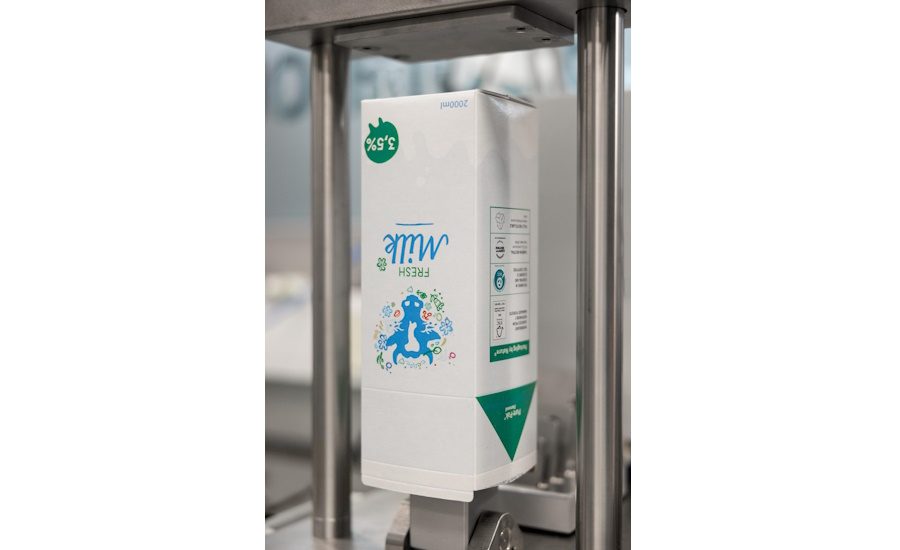
Ultra-clean filling technology addresses this directly. By operating at a hygiene level that significantly reduces microbial risk at the point of fill, it extends the window between production and spoilage, giving dairies, distributors and retailers more time before the product becomes waste. Precision in the filling process also reduces losses during the production itself: faster changeovers between dairy products mean less loss between runs. Recent deployments of Elopak’s UCe filling machine in fresh dairy applications in Italy illustrate the combined effect, with dairies achieving greater efficiency alongside measurably extended product freshness. The result is waste reduction that runs across the whole value chain, not just at the point of packaging.
In practice, the impact is already visible. A mid-sized dairy running multiple stock keeping units (SKUs) can lose significant volumes during routine changeovers, particularly between product variants. Ultra-clean filling systems reduce those losses through faster, more controlled transitions. The hygiene standards they operate at also deliver substantial shelf-life gains: next-generation filling machines equipped with industry leading hygiene features can improve product quality and extended shelf life of the milk to up to 60 days,4 making chilled distribution more cost efficient and reducing waste from short-dated products.
Ultra clean filling technology can improve operational performance through reduced changeover losses, extended shelf life, and increased flexibility in distribution. In addition, fewer products approaching the end of shelf life at retail may contribute to lower levels of markdowns and waste. Beyond the operational case, environmental, social and governance (ESG) performance has become a key factor in retail buying decisions. Dairies who can demonstrate measurable waste reduction across their supply chain, not just at the material level, are increasingly better placed in ranging conversations. What begins as a capital investment in filling technology becomes, over time, a commercial differentiator.
The future of sustainable dairy packaging depends on the system as a whole, not just the substrate, and filling technology sits at the heart of that system. It is the point where material quality, hygiene standards, product integrity and processing efficiency converge. A carton can be designed to the highest sustainability specification, but if the filling process introduces microbial risk, wastes product at changeover, or limits the shelf life that determines how much of that product actually reaches consumption, the system has failed. Ultra-clean filling technology is where those failure points are addressed. Dairies and packaging partners who recognize that will help define what genuinely sustainable dairy looks like in practice. Filling technology that cuts waste and extends shelf life delivers greater impact than material innovation alone.
1 Summary of the Comparative Life Cycle Assessment of Elopak Beverage Cartons and Alternative Packaging Solutions for Fresh Milk and Fresh Juice in North America, May 2021, Elopak Global.
2 ‘Food Waste in America in 2026: Statistics and Facts’, Recycle Track Systems
3 ‘Food loss and waste account for 8-10% of annual global greenhouse gas emissions; cost USD 1 trillion annually’, UNFCCC, 30 September 2024.
4 ‘Elopak rolls out next-generation filling machine to extend shelf life for fresh products’, Fruit Processing, 09 September 2023.